We’ve been doing this sort of thing for decades, Jen and I. We’ve negotiated transport and driver countless times. You think by now we would have learned to ask if the road is paved the entire way. I guess we’re slow learners.
This weekend’s excursion was to Rwanda’s western border with the Democratic Republic of the Congo. Unlike the flat savannahs of the east, western Rwanda is mountainous. So our five hour, partially-paved trip was overflowing with twists, switchbacks, and hairpin turns. Stella beat her Bhutan record and threw up four times during the ride. What a trooper, she collects airsickness bags from all our flights, knowing that we’re likely going to force some nausea inducing adventure on her.
Not helping matters was our driver’s aggressive acceleration-braking, characteristic of those who drive with two feet. Perhaps a technique for our zealous driver to more effectively overtake and pass every bicycle, car, minibus, and lorry that had the affrontery to occupy the road ahead of us. Through a complex semaphore of horn-honking and turn-signal flashing, he would communicate to the other motorists his desire to pass at the next convenient blind curve. Fatalistic drivers like this one always earn me a seat as shotgun. Jen knows that my life insurance has the higher payout. So instead of watching our driver attempt to squeeze three abreast, between an endless succession of buses and oncoming dump trucks, I focused out the side window, at the passing mountains of western Rwanda.
 Around 5000 feet, the topography of western Rwanda reminds me a lot of Appalachia. However, being situated on the equator the curvature of these hills are clothed in a very different flora. In place of the mixed temperate forests of NC or VA, these mountains play host to a more tropical variety. Immediately outside of the capital, the land is parceled in an endless quiltwork of gardens, and small subsistence farms. Broad leaved-banana trees surround homes and run up to plots of corn, peas, sweet potato, melons, cassava. There are stands of bamboo, avocado trees, passion fruit vines. The valley floors are all sectioned into rectangled rice paddies. If any naked earth shows it is the red dirt of my childhood in GA. Shades of green and red are the dominant palate of these hills.
After a while I notice something missing. I’ve not seen any draft animals in Rwanda. There are no oxen tilling those paddies, no donkeys pulling carts of produce. I guess it makes sense. Rwanda is Africa’s most densely populated country. Labor here is cheap. We’re constantly passing bicycles laden down with small mountains of plantains, sweating men and boys pushing them to market.

As we get closer to our destination, the patchwork of gardens gives way to industrial-scale tea plantations. The waist high shrubs are so tightly packed, they make entire hillsides into bright green topiary. The only break, the occasional blue-grey stand of eucalyptus, identifiable by its scent as much as its silvery leaves. The plantations are community co-ops. In addition to a source of local income, these fields form natural barriers around Nyungwe Forest National Park.

Nyungwe is Rwanda’s most important area of biodiversity. 1000 plant species, 13 species of primates including chimpanzee and colobus monkeys, 275 species of birds, 120 different types of butterfly. When we cross into the park we enter a world of nature left to its own business. Now the hills are obscured by curtains of green wild rainforest jungle. Blue monkeys eye us from the roadside and hornbills glide along the valleys. There is so much green it makes a racket for the eyes.
Rwandan soldiers also watch us from the roadside. In body armor, with an impressive array of machine guns, they are a reminder that we are on the border of the DRC. From our hotel room, we can look across Lake Kivu and into that no man’s land of civil war and Ebola. It’s like looking into North Korea, Syria, South Sudan, Yemen. Like standing at the edge of the grand canyon or the top of the Sears tower. It gives you the willies. Some travelers (with a poor sense of self-preservation) actually cross that border tracking gorilla, looking for adventure, hits of adrenalin.
For Byers Without Borders, the hotel buffet was adventure enough. Lily and I spent the majority of Monday prostrate on the cool tile floor of our bathroom in Kigali.
 At 5000 Rwandan Francs (RWF) for a cross-town ride, taxis occupy the top spot in the food chain of transport. No real difference from those at home, assuming your stateside taxi has mirrors held on by zip ties and worn springs that bottom the car out on every bump. Jen normally takes the front seat because of her superior French, however, most of the drivers only speak Kinyarwanda, so the ride often devolves into frustrated pointing at a phone map.
  option. For 1000 RWF (helmet included) you can hop on the back of one of these motorcycle taxis and zip across town, weaving in and out of traffic, in an affront to local traffic laws and every nuanced clause of your travel insurance policy. Arriving at your destination vibrating from adrenaline and itching from the community helmet are just part of the experience.
 one can look serious riding shotgun on the back of a bike, legs held out to the sides in a tin-man pose. It’s like trying to look mad while sipping out of a straw.
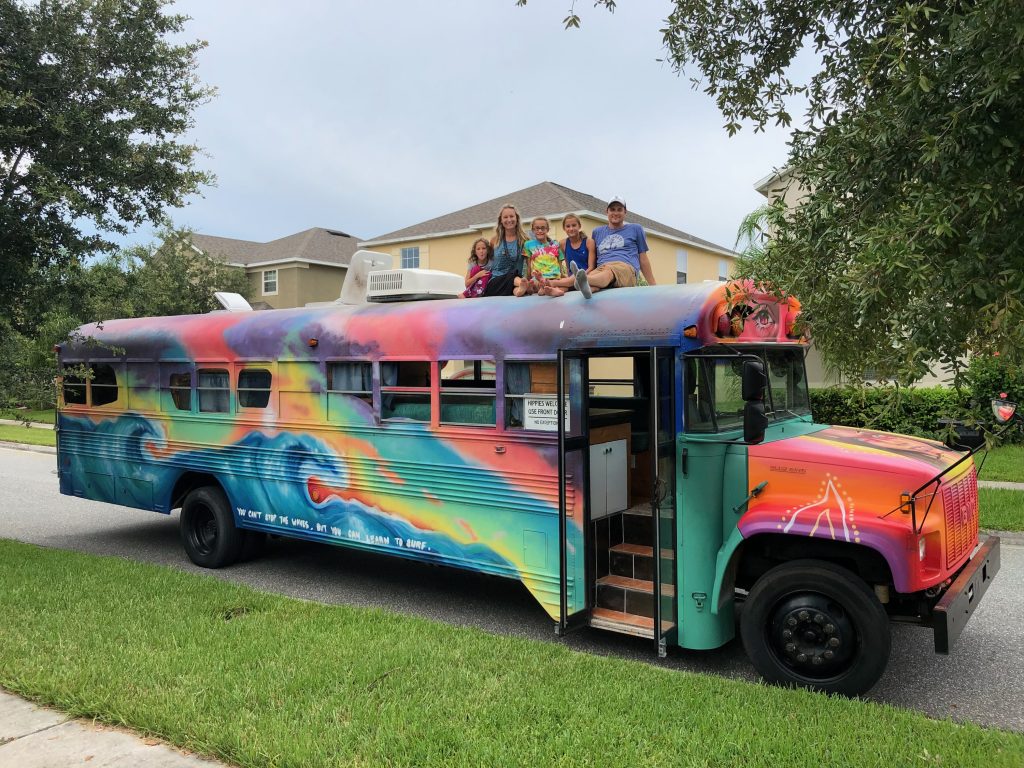
 The better part of a weekend was spent with them, learning their story, and the story of the bus. Stella and their daughter Piper played Barbies. The big kids all went to a chalk-art contest together. In between bus questions, we discussed everything from homeschooling strategies to instapot recipes. We really got to know this sweet family, so it was with a slight sense of guilt that I drove off with their house Sunday afternoon, leaving them with all of their belongings, in a pile, at their empty campsite.

 throughout the Himilaya and is the one we adopted.


